By: Ratu Eroni Ledua Dina (TAAG CEO)
Date: June 09-19, 2026

From June 9th to 10th, I had the privilege of attending the State of the Fijian Economy Dialogue 2026, hosted by Dialogue Fiji at the historic Grand Pacific Hotel in Suva. The room was buzzing with the promise of its theme: “Reshaping Our Future Through Genuine Dialogue.”
But as the CEO of TAAG—a movement dedicated to advocating for Fiji’s most marginalised Vakasa, Sian, and Trans diverse or adjacent (VST+) individuals and communities—I didn’t just listen to the presentations or the 14 resolutions. I watched the room.
What I witnessed was deeply worrying. And it laid bare exactly why our country, and our most vulnerable citizens, continue to be left behind.
A Forum for the Future, Conducted in the Past

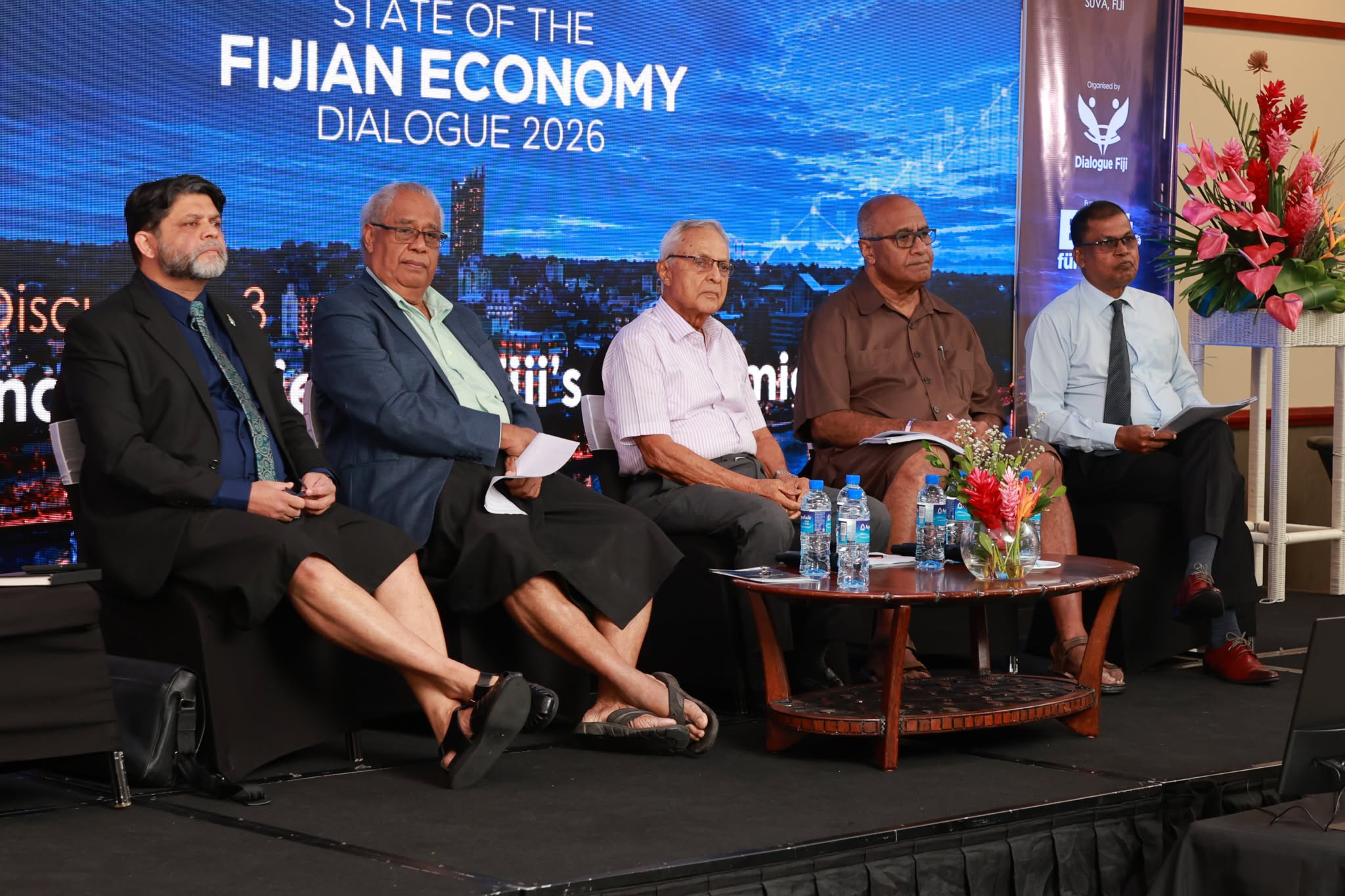
Look closely at the stage from last week’s dialogue. What you see is a row of men who, in various forms, have held or influenced power in this country across the last 40 years. They have lived through every government, every coup, and every constitution since 1987.
Instead of a forward-looking strategy session, the dialogue frequently devolved into a familiar political theatre. We watched a room full of people who have held power in Fiji across various iterations over the last 40 years—through every governmLook closely at the stage from last week’s dialogue. What you see is a row of men who, in various forms, have held or influenced power in this country across the last 40 years. They have lived through every government, every coup, and every constitution since 1987.
                                  FIJI'S LEADERSHIP TIMELINE

   Pre-1987 Era: Long-Term Vision   │   Post-1987 Era: Short-Term Survival
   ──────────────────────────────   │   ──────────────────────────────────
   • 1 Government (17 Years)        │   • 15+ Governments, 4 Coups, 4 Constitutions
   • Built Monasavu Dam & USP       │   • GDP growth plummeted to ~2.3%
   • 4.5% Annual GDP Growth         │   • 29.9% of citizens plunged into poverty
Instead of collectively designing an economic engine for 2045, much of the room’s energy was spent relitigating the past. We watched leaders compare records, blame the administration before them, defend decades-old decisions, and score quick political points.
It hit me with staggering clarity: A forum meant to map out Fiji’s future was being conducted almost entirely in the language of Fiji’s past. The brilliant educator Sir Ken Robinson once noted a truth about political leadership that I haven’t been able to shake since the forum:
“Governments come and go. Politicians come and go. They all have their own agendas and very short attention spans. And meanwhile, millions of people are trying to get educated.”
Substitute “trying to get educated” with “trying to survive,” and you have the reality of the VST+ community in Fiji today. While politicians play a game of musical chairs, our people are just trying to find safe housing, secure a livelihood, and live without fear.
The Power of Long-Term Horizon (The Pre-1987 Era)
To understand how short-sighted our current economic culture is, we have to look at what it means to actually build a nation. Before 1987, Fiji experienced an era of political continuity under Ratu Sir Kamisese Mara. Love him or hate him, that era was defined by a long-term time horizon. Consider what was built then:
- The University of the South Pacific (1968): Built for generations of regional students not yet born.
- The Monasavu Dam (1978–1983): A massive F$234 million investment deep in the interior of Viti Levu that still powers our major cities today.
- The Fiji Pine Commission (1976): Transforming degraded grasslands into long-term wealth for iTaukei landowners.
- International Economic Sovereignty: Negotiating the Lomé Convention to secure sugar prices four times the world market rate to fund rural infrastructure.
None of these achievements delivered full benefits during the political terms in which they were conceived. They required leaders willing to plant seeds for trees whose shade they would never sit under.
The Cost of Short-Term Factionalism since 1987
Since 1987, Fiji has cycled through more than 15 governments, four coups, and four constitutions. Each wave brought a new agenda that dismantled what came before it.

The result? GDP growth collapsed from an average of 4.5% in the early era to a meager 2.3%. Today, 29.9% of our people—roughly 258,000 Fijians—live in poverty, and 75% of those individuals are iTaukei. Ironically, this is the very community every coup since 1987 claimed to protect.
When a political culture is trapped in short-term “coup cycles” or “election cycles,” it completely loses the capacity to see the human beings buried under the statistics.
What This Means for VST+ Communities
When the state fails to think in decades, the impact is not distributed evenly. It hits marginalized communities first and hardest.
- Economic Exclusion as a Sub-Product of Instability: When public investment falls apart, social safety nets vanish. For VST+ individuals, who already face systemic discrimination in formal hiring, a stagnant economy means they are pushed entirely into volatile, unsafe informal sectors.
- The Talent Drain (Human Resources are Natural Resources): Sir Ken Robinson rightly stated that human resources are like natural resources—buried deep, requiring you to look for them. Fiji’s greatest asset is its people. Yet, because of continuous instability, we have exported our talent to Australia, New Zealand, and beyond. For LGBTQI+ and VST+ professionals, this brain drain is doubly fueled by the search for basic human rights and safety. The remittances sent home are simply a band-aid on a hemorrhaging nation.
- The Tokenism of “Inclusion”: In a political culture obsessed with point-scoring, marginalized groups are treated as talking points rather than equal stakeholders. We hear a lot of progressive language during high-level dialogues, but zero long-term legislative protections or budgetary allocations follow.
Shifting from Competition to a Shared Project
The problem with Fiji’s economy is not a lack of resources, nor is it a lack of well-written resolutions. The problem is a political culture that treats this country as a competition between factions rather than a shared project for future generations.
And as citizens, we are not innocent bystanders. When we vote purely along ethnic or dogmatic lines, we signal to our leaders that short-term rhetoric matters more than long-term substance.
At TAAG, we are constantly working to build a future where every Fijian—regardless of their gender identity, sexual orientation, or socioeconomic status—has a dignified place in our economy. But we cannot do this alone while our national leaders remain stuck in a loop of historical grievance.

Our Challenge to Fiji’s Leadership
To the organizers of the dialogue, thank you for creating the space. To the leaders who sat in that room: We respect your service, but we challenge you to prove us wrong.
Stop measuring your success by how much worse the previous government was. Start measuring it by the Fiji you are supposed to be building for 2045.
Who in Fiji today is building something they will never see the full benefit of?
That is the question our leaders should have been asking at the Grand Pacific Hotel. That is the question we must all start demanding answers to.
👉 If you believe that Fiji deserves a future built on decades of vision, not election cycles, please share this blog. Let’s change the dialogue.
Leave a Reply