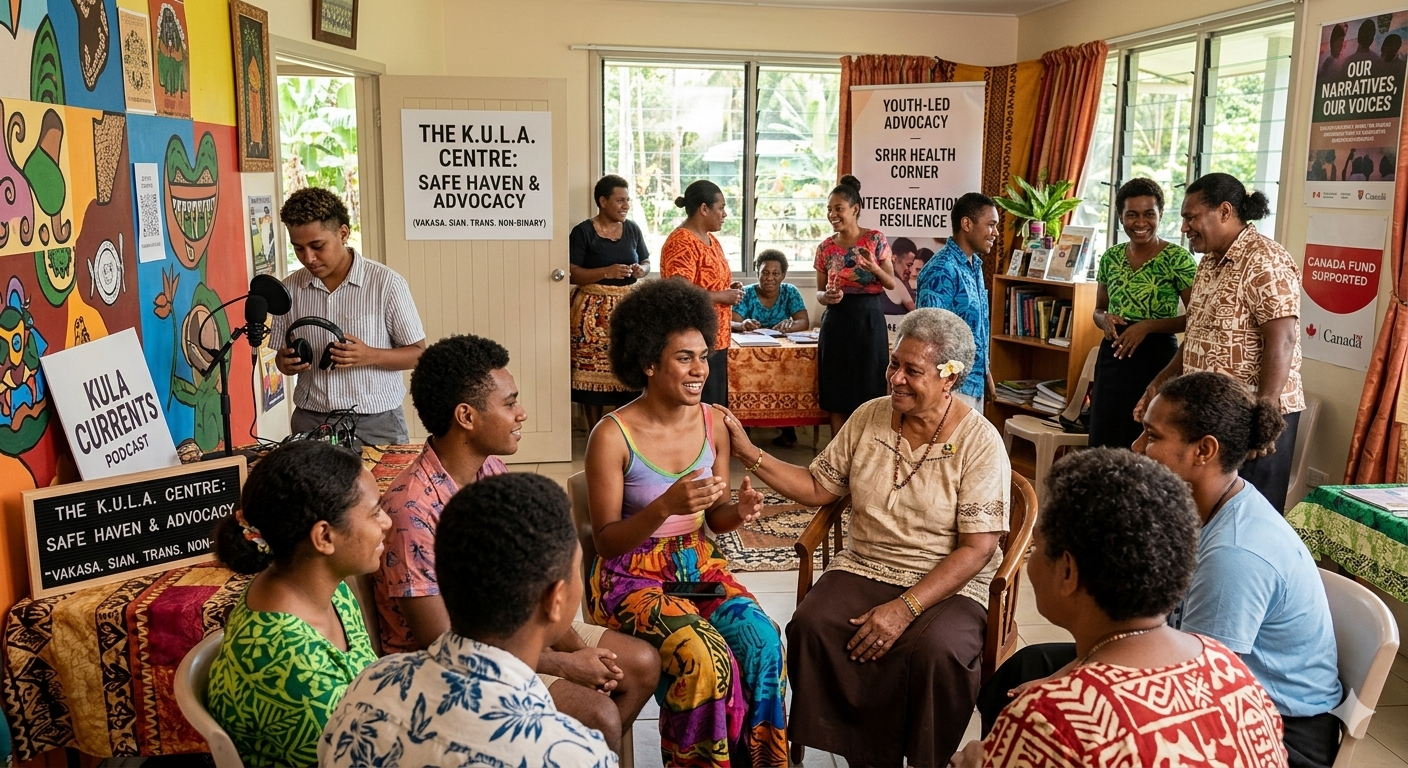
Fostering Intergenerational Resilience and Safe Spaces for VST+ Youth
THE CONCEPT:
Background and Rationale
Fiji’s human rights journey is marked by critical advancements in protecting its most marginalized populations. A cornerstone of modern constitutional protections is the explicit safeguard against discrimination based on sexual orientation, gender identity, and expression. This progressive framework creates a vital legal and social baseline for the rights and dignity of Fijians of diverse SOGIESC (Sexual Orientation, Gender Identity and Expression, and Sex Characteristics) communities. However, despite these high-level protections, a severe implementation gap persists at the grassroots community level, where structural vulnerabilities intersect with cultural and socio-economic pressures.
The current social landscape for Vakasa, Sian, Trans, and Non-binary (VST+) individuals in Fiji is defined by systemic marginalization, high rates of mental health crises, acute social isolation, and exclusion from mainstream development initiatives. This vulnerability is not abstract; it is grounded in a growing trend of conservative rhetoric and rigid religious or traditional interpretations that enforce cultures of shame, actively limiting the social, physical, and political participation of gender-diverse folx. Conversely, pre-colonial Pacific traditions hold deep histories of gender fluidity, offering a vital yet underutilized source of indigenous resilience. There is an immediate, time-sensitive necessity to establish a trauma-informed, physical and digital sanctuary that counters these modern pressures. This project is a direct, structural intervention designed to bridge this cultural disconnect, provide localized healing justice, and cultivate long-term community agency.
Organisational Profiles
The K.U.L.A. Centre project will be a strategic collaboration between the Trans Affirmative Action Guild (TAAG) and the Pacific Sexual & Gender Diversity Network (PSGDN). The Trans Affirmative Action Guild (TAAG) is a grass-roots, human rights and community advocacy organization dedicated to advancing the dignity, protection, and socioeconomic empowerment of VST+ individuals in Fiji. Our work is grounded in the principles of intersectionality, healing justice, and indigenous leadership. The Pacific Sexual & Gender Diversity Network (PSGDN) is a regional network working across the Pacific to influence policy, strengthen institutional capacity, and advocate for legal frameworks that protect SOGIESC communities.
Goal and Objectives
Overall Goal
The overall goal is to establish and operationalize a permanent community hub that provides safe, trauma-informed physical and digital spaces to foster intergenerational mentorship, mental health support, and narrative empowerment for the VST+ community in Fiji.
Objectives
By the end of the 12-month project cycle, the initiative will have:
- Operationalized a Safe Haven: Established a functional physical sanctuary in Fiji equipped to deliver peer support, community building spaces, point-of-contact SRHR testing, and gender-affirming medical referrals.
- Built Crisis Intervention Systems: Recruited and trained a dedicated cohort of Youth Peer Leads to deploy and maintain a sustainable, youth-led crisis helpline.
- Launched a Digital Advocacy Platform: Created and distributed the KULA Currents podcast, providing a youth-driven storytelling platform to challenge societal stigma and reclaim VST+ narratives.
- Institutionalized Intergenerational Mentorship: Integrated matua (elders) into the core programmatic structure, securing lasting pathways for the transfer of cultural knowledge and resilience.
Thematic Focus and Key Discussion Areas
The project’s framework is designed to transition beneficiaries logically from isolation to active leadership and collective healing. The primary thematic areas encompass:
- Healing Justice and Physical Safety: Creating zero-barrier safe spaces that mitigate the immediate risks of suicide, homelessness, and depression among at-risk youth.
- Bodily Autonomy and Health Access: Integrating decentralized health screening with secure, confidential pathways for gender-affirming care.
- Indigenous Reclamation and Cultural Continuity: Utilizing traditional Pacific frameworks to dissolve generational gaps and restore the cultural status of VST+ folx.
- Narrative Ownership and Digital Literacy: Equipping youth with media skills to lead public advocacy and counter institutionalized discrimination.
Methodology and Approach
Trauma-Informed Community Mobilization
The establishment of the centre will reject top-down implementation, relying instead on horizontal, peer-led mobilization. Safe space design, resource mapping, and helpline operational hours will be co-designed by beneficiaries to ensure the infrastructure matches their lived realities.
Phased Monitoring and Evaluation (M&E)
To ensure rigid institutional accountability, the project implements a mixed-methods data approach. A rigorous Baseline Survey in Month 1 establishes quantitative and qualitative metrics regarding community well-being and service accessibility, which will be cross-analyzed against an Endline Survey in Month 12 to provide empirical proof of impact for future strategic scaling.
Facilitated Talanoa Frameworks
Programmatic components, particularly intergenerational sessions between youth and matua, will be conducted via culturally grounded Talanoa models. This ensures a secure environment for constructive dialogue, sharing oral histories, and co-creating community protection strategies.
Target Participants
The K.U.L.A. Centre is an inclusive space strategically designed to serve a focused yet intersectional demographic:
- VST+ Youth: Peer leads and project beneficiaries facing acute socio-economic or psychological vulnerability.
- Matua (Elders): Traditional knowledge holders and gender-diverse elders acting as anchors for cultural and spiritual grounding.
- Human Rights Defenders & Medical Experts: Technical resource persons providing specialized care, legal backstopping, and administrative oversight.
Expected Outcomes and Outputs
Key Outcomes (Longer-term impact)
- A permanent, highly resilient, and self-sustaining infrastructure for VST+ community organizing and localized protection mechanisms in Fiji.
- Enhanced psychological well-being, reduced isolation, and measurable reductions in suicide risks among urban and peri-urban gender-diverse youth.
- Shifted public and political discourse regarding SOGIESC identities through high-visibility, youth-led digital media and narrative ownership.
- A robust, evidence-based data repository (via Baseline and Endline surveys) to leverage for long-term regional human rights advocacy and donor engagement.
Tangible Outputs (Immediate deliverables)
- One (1) fully operational K.U.L.A. Centre equipped with workspace, soundproof audio gear, and an integrated health referral corner.
- One (1) functional, youth-led peer helpline operated by a minimum of four (4) trained, stipended Youth Peer Leads.
- A multi-episode deployment of the KULA Currents podcast, uploaded across major streaming and social platforms with clear analytics tracking.
- Two (2) comprehensive data publications, capturing the baseline realities and endline progress of VST+ individuals under colonial-era legal frameworks.
Leave a Reply